NFL Live Betting UK — In-Play NFL Wagering Guide 2026
 Available in US
Table of Contents
- Why In-Play Betting Is the Fastest-Growing NFL Market
- NFL Live Markets Available at UK Bookmakers
- Timing Your Live Bets: Quarters, Drives, and Momentum Shifts
- Using Cash Out on NFL In-Play Bets
- AI and Micro-Betting: The Next Wave
- Pitfalls of NFL Live Betting and How to Avoid Them
- Where Live Betting Fits in Your NFL Strategy
Two years ago, I placed a live bet on a fourth-quarter drive that changed how I think about NFL wagering entirely. The Dolphins were down ten with eight minutes left, the pre-game spread was long dead, and the live line offered Miami +3.5 at 6/5. They scored twice and covered. The pre-game market had been wrong for hours, but the live market caught up in seconds — and I was on the right side of it because I was watching.
That experience crystallised something I’d been noticing for a while: in-play betting isn’t just an add-on feature at UK bookmakers. It’s becoming the primary way informed punters engage with NFL games. In European football, live betting already accounts for more than 60% of all online wagers. The NFL is following the same trajectory, driven by streaming access, faster odds engines, and a sport whose structure — discrete plays, constant stoppages, clear momentum swings — is almost perfectly designed for real-time wagering.
This guide covers everything a UK-based NFL bettor needs to know about in-play markets: what’s available, how to time your bets, when to use cash out, and where AI-powered micro-betting is taking the whole category next. I’ve been betting NFL games live since 2020, and every season the market gets deeper, faster, and more interesting. Here’s how to navigate it.
Why In-Play Betting Is the Fastest-Growing NFL Market
During the 2023 NFL season, I tracked every bet I placed and categorised them by timing. By week 18, 43% of my total action was in-play — up from about 15% two seasons earlier. I hadn’t consciously shifted. The markets had simply gotten good enough that live betting became the rational choice more often than pre-game.
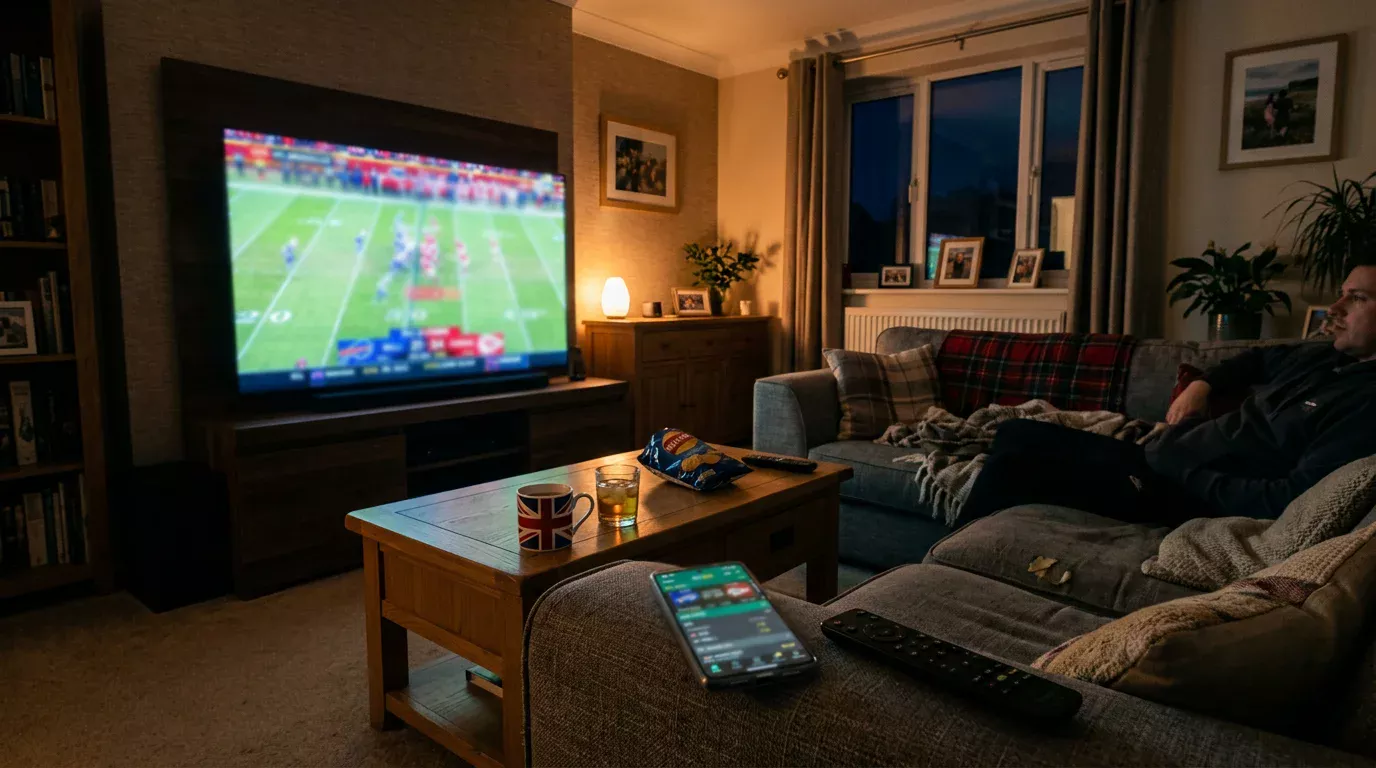
The numbers across the industry tell the same story. In European football, more than 60% of all online bets placed in 2024 were in-play. The NFL hasn’t reached that proportion yet, but the gap is closing fast. Mobile wagering — which now accounts for 78% of all online sports bets globally — is the accelerant. A punter sitting on the sofa watching Amazon’s Thursday Night Football can open an app, see the live spread, and place a bet without looking away from the screen. The friction between watching and wagering has essentially disappeared.
Three factors are driving this growth specifically for the NFL. First, the sport’s stop-start structure creates natural betting windows. Between plays, during timeouts, at the two-minute warning, and between quarters, the clock stops and odds recalibrate. Unlike football or basketball, where play is continuous and live odds are a moving target, the NFL gives you pauses to think. Second, the information flow during an NFL game is extraordinary. Injury updates hit social media within seconds. Coaches challenge plays, and the outcome reshapes the spread in real time. Weather shifts mid-game. Each of these events creates a new market — and a new opportunity for a bettor paying closer attention than the algorithm. Third, the broadcast infrastructure in the UK has expanded dramatically. Between Sky Sports, ITV’s free-to-air deal, and Amazon Prime Video’s Thursday Night Football — which reached 96.8 million unique viewers by mid-season 2025, a double-digit increase year on year — UK punters have more live access to NFL games than ever before.
Equity Research Analyst Jordan Bender has pointed to an interesting tension in the market: the growth of prediction markets alongside traditional sportsbooks is creating competitive pressure on legal operators, particularly around major events. That pressure, paradoxically, is making live odds more competitive for bettors. Bookmakers are sharpening their in-play pricing to retain customers who might otherwise drift to alternative platforms. For UK punters, this means better lines and deeper markets than even two years ago.
NFL Live Markets Available at UK Bookmakers
Not every bookmaker offers the same live NFL menu, and the differences matter more than most punters realise. I keep accounts at four UKGC-licensed platforms specifically because their in-play NFL coverage varies. One might offer drive-result markets that another doesn’t. Here’s the landscape.
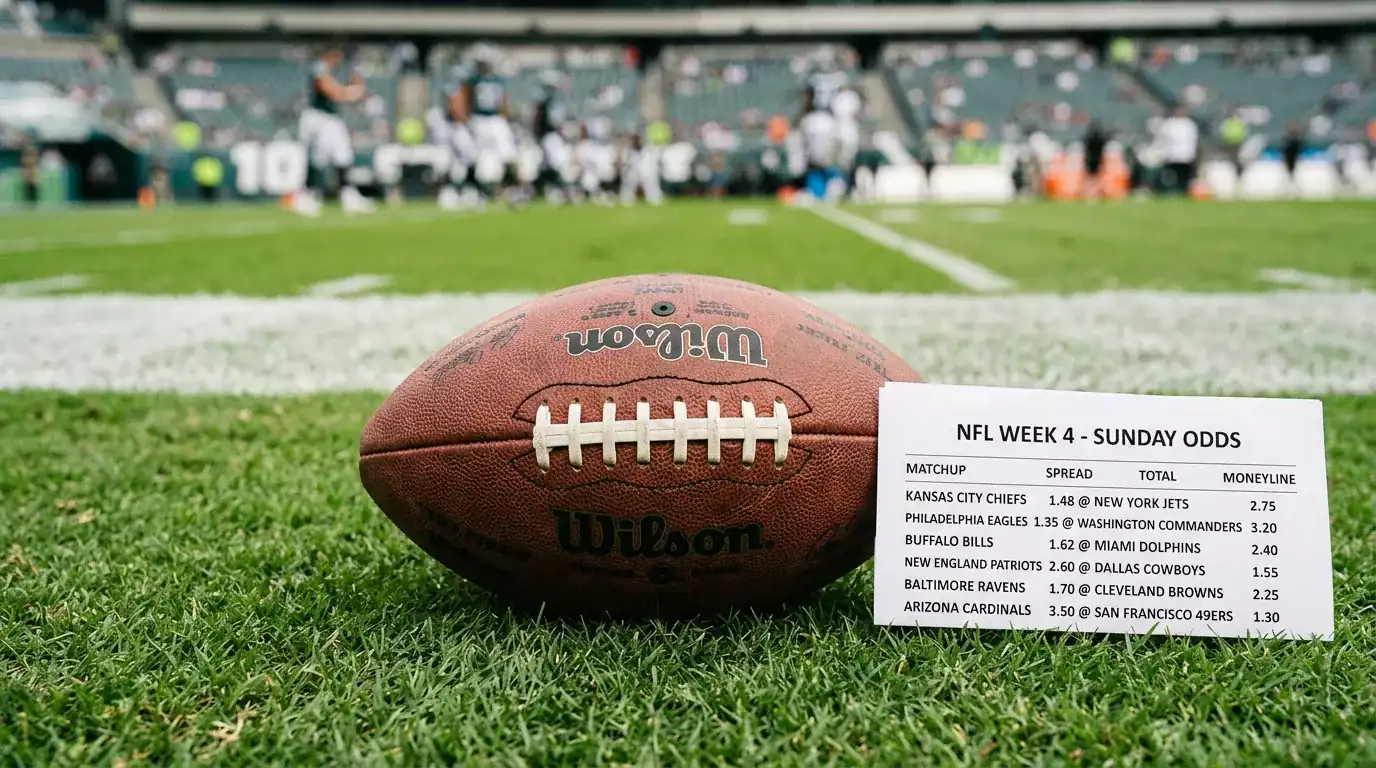
The core live markets you’ll find at virtually every major UK bookmaker during an NFL broadcast are: live spread (the adjusted point spread based on current score and game state), live moneyline (who wins from this point forward), live totals (adjusted over/under for the final combined score), and next scoring play (touchdown, field goal, or safety). These four are the bread and butter. If a bookmaker doesn’t offer all four during a primetime NFL game, they’re not serious about the sport.
Beyond the core, the market depth splits into tiers. Mid-tier platforms add: quarter-by-quarter spreads and totals (bet on the third quarter spread independently of the full game), next team to score, and live player props such as the next quarterback to throw a touchdown or the next running back to score. Top-tier platforms push further into drive-level markets — will this drive result in a touchdown, field goal, punt, or turnover? — and offer alternate live spreads, allowing you to buy or sell points in real time just as you would pre-game.
Mobile speed is the hidden variable. Live NFL odds are only useful if they reach your screen before the next play starts. The NFL’s average time between plays is roughly 40 seconds, but during hurry-up offences or the two-minute drill, that window can shrink to 15 seconds. In my experience, app-based live betting is meaningfully faster than desktop at two of my four bookmakers, and roughly equal at the other two. If you’re serious about in-play NFL wagering, test the latency of your platform’s mobile app before committing real money. Place a few small bets during a preseason game and note how quickly the odds update and how smoothly the bet placement process flows.
One pattern I’ve noticed over the past three seasons: UK bookmakers are expanding their NFL live menus fastest during the Thursday and Monday night games. These are standalone broadcasts with maximum viewership and maximum betting volume, so the operators invest their best in-play technology in those windows. Sunday early-window games (6pm UK time) sometimes get thinner live coverage, particularly for matchups between lower-profile teams. If in-play is your primary approach, prioritise your bankroll toward the primetime slots where market depth is richest.
Timing Your Live Bets: Quarters, Drives, and Momentum Shifts
Here’s a mistake I made for my entire first season of NFL live betting: I treated every minute of the game the same way. A bet in the first quarter and a bet in the fourth quarter got the same analysis, the same stake, the same urgency. That’s wrong. An NFL game has a rhythm, and the live market follows it. Learning where the value concentrates — and where it evaporates — took me a full season of tracking every in-play bet I placed.
The first quarter is the noisiest period for live betting. Pre-game lines are still fresh, and a single early score can swing the live spread dramatically. I’ve seen a 14-0 first quarter turn a -3 favourite into a -14 live favourite, only for the trailing team to rally and win outright. The market overreacts to early scoring because the sample size is tiny — a team that’s scored once in five minutes hasn’t revealed anything about their true quality. My approach: I rarely bet in the first quarter unless I’ve identified a specific pre-game angle that the early action confirms. If I expected the underdog’s defence to struggle against the run, and the favourite rips off two rushing touchdowns in the first ten minutes, that confirms my thesis and I’ll consider a live bet on the favourite at the adjusted spread.
The second quarter is where the market starts to settle. Both teams have run 20-plus plays, you’ve seen their game plans unfold, and the live spread begins reflecting the actual matchup rather than the pre-game projection. This is my highest-volume window. I’m looking for games where the live spread has moved too far from where I think the true line should sit. A team trailing 10-0 at halftime might be priced at +10.5 live, but if their first-half performance was marred by two turnovers in their own territory rather than any systemic mismatch, +10.5 is an overreaction.
Halftime is a reset point. Some bookmakers briefly suspend markets; others offer halftime-specific lines (second-half spread, second-half total). I find second-half unders particularly interesting because coaches make defensive adjustments at halftime, and the second-half scoring rate in the NFL is historically lower than the first.
The third quarter is the sharpest window for live betting. The market has 30 minutes of game data. Adjustments are being deployed. And crucially, the public tends to step back during the third quarter — it’s less dramatic than the first half’s opening or the fourth quarter’s finish. Reduced public volume often means less noise in the odds, which means the price is closer to true.
The fourth quarter and overtime are where discipline matters most. The urgency is real, the swings are violent, and the temptation to chase is at its peak. I have a hard rule: no live bet in the final two minutes of regulation unless I’ve identified it before the two-minute warning arrives. If I’m scrambling to place a bet because the score just changed, I’m reacting, not analysing. Reacting is the live bettor’s worst enemy.
Using Cash Out on NFL In-Play Bets
Cash out is the feature that seduces every new live bettor and frustrates every experienced one. Let me tell you why I use it sparingly, and when I think it’s genuinely worth the cost.
Cash out lets you settle a bet before the game ends, locking in a profit or cutting a loss based on the current live odds. If you backed the 49ers at +7 and they’re now leading by three, your bookmaker might offer you a cash-out value of 80% of the potential full payout. You take the guaranteed money now, or you ride it out and risk the 49ers collapsing in the fourth quarter.
The fundamental problem with cash out is that the bookmaker prices it with a margin. The cash-out offer is always slightly worse than the theoretical fair value of your bet at that moment. Over hundreds of uses, that margin adds up. I think of cash out as an insurance policy: useful in specific situations, but expensive if you buy it on every bet.
When do I use it? Three scenarios. First, when new information fundamentally changes my read. If I bet on a team’s live spread and their starting quarterback gets injured during the third quarter, the game I handicapped no longer exists. Cashing out isn’t weakness — it’s responding to changed conditions. Second, when the cash-out value exceeds a threshold I set before the game. I sometimes decide in advance: “If this bet reaches 70% of max payout, I’ll cash out.” Having the exit planned before the game prevents emotional decision-making during it. Third, on large-stake bets where securing profit meaningfully impacts my bankroll. If I’ve placed a bet that represents 3-4% of my bankroll (larger than my standard 1-2%), cashing out for a guaranteed return can be prudent risk management.
When do I avoid it? Almost every other time. The temptation to cash out a winning bet early usually means you’re afraid of losing what you’ve gained. That fear is normal, but acting on it systematically erodes your edge. If your pre-game or live analysis was sound, the bet should run to completion. The games where you’d have been better off cashing out are the same games where hindsight makes every decision look wrong. You can’t optimise for hindsight. You can only optimise for process.
AI and Micro-Betting: The Next Wave
In August 2024, DraftKings acquired Simplebet, an AI-powered micro-betting company, for a deal that signalled where the entire industry is heading. Simplebet’s technology generates odds for individual plays — not quarters, not drives, but single snaps. Will the next play be a run or a pass? Will the quarterback be sacked? Will the receiver catch this specific target? These markets exist for fractions of a second and settle within moments.
Micro-betting takes the principles of live wagering and compresses them into their smallest possible unit. Instead of betting on the outcome of a drive or a quarter, you’re betting on the outcome of a single play. The speed required to set and adjust these odds exceeds human capability, which is why AI models — trained on millions of historical play-by-play data points — are essential. No team of human oddsmakers could price the probability of a third-and-seven conversion in the two seconds between the play clock starting and the snap.
For UK punters, the immediate question is availability. As of 2026, full-depth micro-betting is not yet standard at UKGC-licensed platforms. The technology is largely deployed through US-facing operators and their proprietary apps. However, elements of it are filtering through. Several UK bookmakers now offer “next play” markets during primetime NFL broadcasts — a simplified version of micro-betting that covers run/pass, first down yes/no, and scoring play yes/no. These markets update faster than traditional in-play lines and settle within seconds of the play’s conclusion.
The strategic implications are worth thinking about even before full micro-betting arrives in the UK market. AI-set odds are harder to beat than human-set odds because the models process more variables faster. But they also have blind spots. AI models are trained on historical data, which means they can underweight genuinely novel game situations — a trick play, an unusual formation, a coaching decision that breaks pattern. The bettors who will thrive in a micro-betting environment are those who understand the game at a play-calling level, not just a scoreboard level.
My view: micro-betting will eventually become a significant portion of NFL live wagering in the UK, just as it’s becoming in the US. Whether that’s good for bettors depends on how you approach it. Treated as entertainment — small stakes, rapid feedback — it’s a compelling way to engage with a game. Treated as a serious wagering strategy, it demands a level of speed and discipline that most punters (myself included) are still developing. The technology is ahead of the skill base, and that gap is where the bookmakers will profit most in the early years.
Pitfalls of NFL Live Betting and How to Avoid Them
Live betting amplifies everything — your analysis, your emotions, and your mistakes. The same features that make it compelling (instant feedback, constant action, the feeling of being inside the game) are precisely what make it dangerous for punters who don’t set boundaries.
The biggest pitfall is volume. A single NFL game offers dozens of live betting opportunities across three-plus hours. Bet on too many of them and you’re not analysing — you’re gambling in the purest sense of the word. I limit myself to a maximum of three live bets per game, decided before kickoff. If I identify three potential spots (a second-quarter spread if the underdog falls behind early, a third-quarter total, and a fourth-quarter moneyline if the game is within a score), I write them down. If none of those scenarios materialise, I don’t bet. Having a plan isn’t just discipline; it’s the infrastructure that separates a strategy from a compulsion.
The second pitfall is chasing the pre-game bet. You backed the favourite at -3 pre-game, and they’re down 14-0 in the second quarter. The live spread now offers them at +4.5. The temptation is to double down — “They’ll come back, and now I’m getting even better value.” Sometimes they do come back. But doubling your exposure to a game that’s already going against your analysis is a bankroll management failure. If your pre-game thesis was wrong, the correct response is to accept the loss, not compound it.
The third pitfall is ignoring the margin. Live odds carry a wider margin than pre-game odds because the bookmaker is pricing uncertainty in real time. A pre-game spread might carry 4-5% margin; a live spread during a volatile fourth quarter can carry 8-10%. You’re paying more for every live bet, and over a season, those extra percentage points erode your return. Be selective. The fewer live bets you place, the less margin you surrender.
I want to be direct about something that sits beneath all of these tactical pitfalls: live betting can be addictive in a way that pre-game betting is not. The speed, the dopamine of instant settlement, the sense of control — these are psychologically potent. The UK Gambling Commission reports that 2.7% of the adult population — approximately 1.4 million people — score at problem-gambling levels. Live betting, with its constant stimulation, poses a heightened risk for anyone susceptible. If you find yourself placing live bets compulsively, increasing stakes to chase excitement, or struggling to step away from a game, those are signals worth taking seriously. Tools like deposit limits, session timers, and structured bet-building approaches can help impose boundaries that keep live betting a calculated activity rather than a reactive one.
Where Live Betting Fits in Your NFL Strategy
In-play NFL betting is not a replacement for pre-game analysis. It’s an extension of it. The punters who profit from live markets are the ones who’ve done the homework before kickoff — who know the matchup, understand the coaching tendencies, and have identified the scenarios where live value is most likely to appear. Walk into a game with a plan, limit your live action to the spots that match your plan, and treat every live bet as a discrete decision rather than part of a running narrative. The game is three hours of chaos. Your betting doesn’t have to be.
Which UK bookmakers offer the widest range of NFL in-play markets?
The depth of NFL live markets varies significantly across UKGC-licensed platforms. Larger operators with US-affiliated parent companies tend to offer the deepest menus, including drive-result markets, live player props, and quarter-by-quarter lines. Test several platforms during preseason games to compare market depth and app speed before committing your bankroll.
How quickly do live NFL odds change during a game?
NFL live odds update after every significant event: scores, turnovers, penalties, injuries, and sometimes individual plays. During normal game flow, the live spread might adjust every 30-60 seconds. During hurry-up offences or the two-minute drill, odds can shift every 10-15 seconds. The speed depends on both the game situation and the technology powering your bookmaker’s platform.
Is cash out available on all NFL live bets?
Not always. Cash-out availability varies by bookmaker and by market type. Most UK platforms offer cash out on live spreads and moneylines, but drive-result bets and micro-bets typically settle too quickly for cash out to be practical. Check your bookmaker’s terms — some restrict cash out during certain game situations or when odds are moving rapidly.
What is micro-betting in NFL and is it available in the UK?
Micro-betting lets you wager on the outcome of individual plays — a single snap, a specific pass attempt, a rushing play. AI models price these markets in fractions of a second. Full micro-betting is not yet standard at UK bookmakers, though simplified ‘next play’ markets are increasingly available during primetime NFL broadcasts. The technology is advancing quickly and wider UK availability is expected in coming seasons.
Find the best options for bet nfl games.
Read our detailed review of NFL London Games Betting — Odds, Trends, and Strategy.
Written by the editors at bet nfl Games.