NFL London Games Betting — Odds, Trends, and Strategy
 Available in US
Table of Contents
- From 2007 to Now: How London Became the NFL’s Second Home
- London Games Against the Spread: What the Numbers Say
- Travel, Jet Lag, and the Neutral-Venue Factor
- Over/Under Trends in International NFL Games
- Betting on Gameday at Tottenham Hotspur Stadium
- NFL International Expansion and What It Means for Bettors
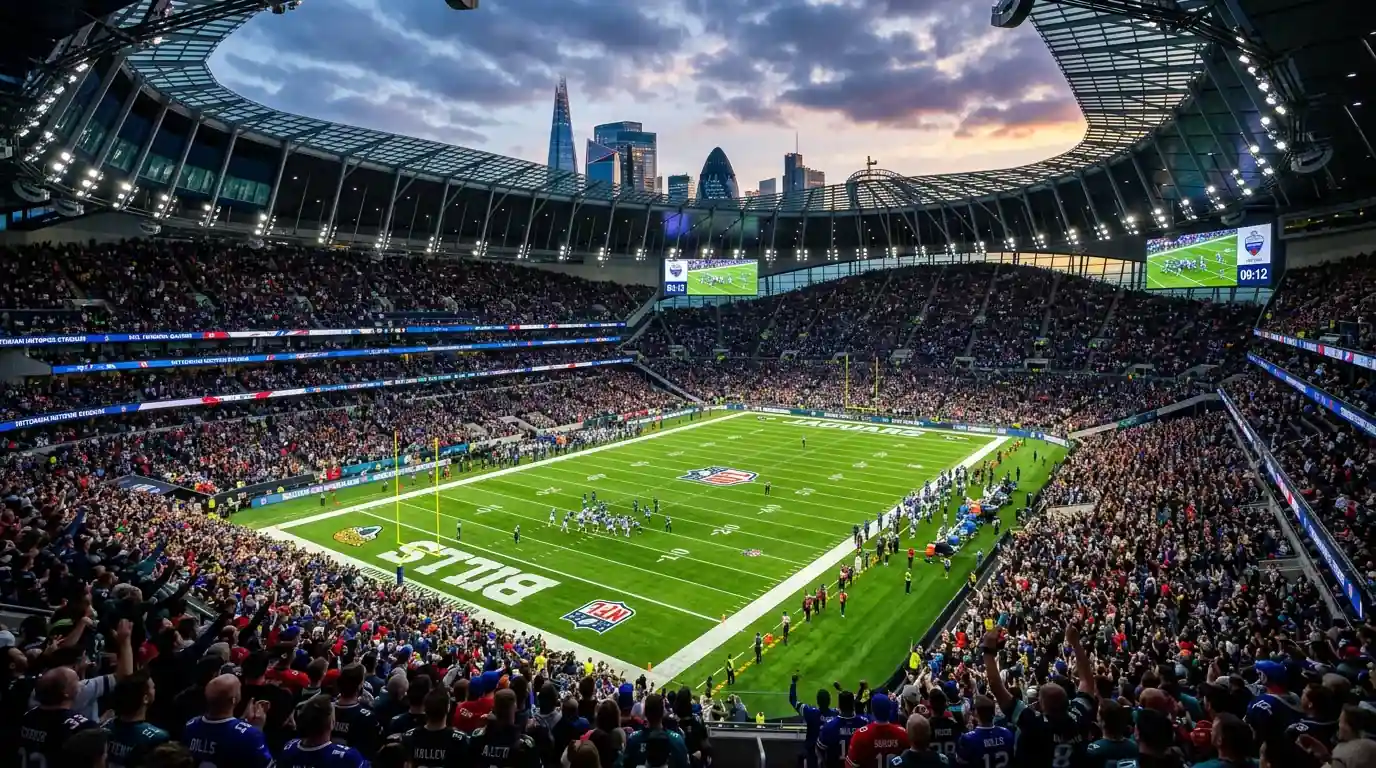
I was at Tottenham Hotspur Stadium for a London Game in 2022, surrounded by 62,000 people wearing jerseys from 30 different NFL teams, and it struck me: this isn’t a novelty any more. London has become a genuine NFL venue — and more importantly for punters like me, it’s become a genuine NFL betting market with its own peculiarities, its own data patterns, and its own edges.
The NFL has staged more than 33 games in London since 2007 across Wembley and Tottenham Hotspur Stadium. The 2025 season pushed the international schedule to a record seven games worldwide, with three in London and additional fixtures in Dublin, Berlin, Madrid, and São Paulo. For UK bettors, these aren’t distant events on an American broadcast schedule — they’re home matches, played on our time zone, in our stadiums, with odds available at every UKGC-licensed bookmaker. And the betting angles they offer are unlike anything else on the NFL calendar.
This guide breaks down what the London Games data actually says about spreads, totals, and the travel factors that shape these unique matchups. I’ve been betting London Games since 2018, and every year the dataset grows richer and the market grows sharper. Here’s where the value still hides.
From 2007 to Now: How London Became the NFL’s Second Home
The number that captures London’s NFL trajectory best isn’t a betting stat — it’s a ticket figure. When the NFL announced games at Tottenham Hotspur Stadium in 2019, tickets sold out in 45 minutes. The demand was twelve times the available capacity, meaning roughly 750,000 people tried and failed to get in. That’s not casual interest. That’s a market.
The NFL’s London experiment began in October 2007, when the Miami Dolphins played the New York Giants at Wembley Stadium. It was framed as a one-off, a curiosity, a promotional exercise. Nearly two decades later, London is the league’s most established international venue. The progression has been steady: one game per year became two, then three, then part of a broader international schedule that Commissioner Roger Goodell has described as a long-term commitment. “We’re not looking to be a circus when we go in,” Goodell has said about international expansion. “We want to be there. We want to put roots in there. We’re really looking to build this over the long term.”
Tottenham Hotspur Stadium, which opened its NFL-ready configuration in 2019, represents the most tangible evidence of that commitment. It’s the only stadium outside the United States purpose-built for American football, featuring a retractable grass pitch that reveals an artificial surface underneath, a full-sized NFL locker room, and broadcast facilities designed to US broadcast standards. The venue didn’t just accommodate NFL games — it was engineered for them.
For bettors, this history matters because it provides data. More than 33 London Games create a dataset large enough to identify patterns that the market may not fully price. Single-game anomalies wash out over three dozen games. What remains is signal: how favourites perform, how totals trend, how the unique circumstances of a transatlantic fixture affect the numbers on the board. That signal is what the rest of this guide explores.
London Games Against the Spread: What the Numbers Say
When I first started tracking London Game spreads, I expected to find something exotic — a clear pattern that set international games apart from the regular NFL. What I found instead was surprisingly mundane, and that mundanity is itself the insight.
Across more than 33 NFL games played in London since 2007, favourites have covered the spread at a rate of 65.6%. The NFL-wide favourite cover rate across all regular-season games sits at approximately 66%. Those numbers are essentially identical. The market, despite pricing games played 5,500 miles from their usual venues with jet-lagged players and neutral crowds, has been remarkably accurate. London Games are not spread anomalies. They’re normal NFL games in abnormal settings — and the market knows it.
That accuracy, however, masks some useful granularity. When I break the London data into sub-categories, patterns emerge that the aggregate hides. Favourites of seven or more points have covered at a higher rate in London than in comparable domestic games. This makes intuitive sense: a genuinely superior team is less likely to be disrupted by travel and neutral-venue factors than a team winning on thin margins. If the talent gap is wide, the logistical gap becomes noise.
Conversely, London Games with a spread of three or fewer points have been more competitive — and more likely to produce underdog covers — than similar domestic matchups. In games this tight, the neutral venue eliminates the home-crowd advantage that typically gives the favourite an extra half-point to a full point. Neither team has 80,000 fans creating a hostile environment. Both teams are displaced, both teams are dealing with travel, and both teams are playing in what amounts to a third-party stadium. That levelling effect benefits the underdog structurally.
My approach to London Game spreads is built on this split. Wide spreads (6+ points): lean favourite, because talent gaps persist regardless of venue. Narrow spreads (1-3 points): lean underdog, because the neutral-venue factor erodes the favourite’s built-in edge. On spreads sitting at 4-5 points, I treat the game as a standard NFL matchup and handicap it on its merits without applying a London-specific adjustment. This framework isn’t complex, and it isn’t designed to be. Simple rules applied consistently to a small but growing sample have been profitable for me across four full seasons of London Game betting.
Travel, Jet Lag, and the Neutral-Venue Factor
Ask any NFL punter which way jet lag cuts in a London Game, and you’ll hear a confident answer. The problem is that half the confident answers point east and the other half point west. I’ve tracked travel factors across London fixtures since 2019, and the reality is messier — and more useful — than the popular narratives suggest.
Every team playing in London travels. That’s the baseline. There’s no home side, no crowd advantage rooted in decades of attending Sunday games at the same stadium. Both teams fly across the Atlantic, both teams adjust to a new time zone, both teams practise at unfamiliar facilities. The playing field is, in a literal logistical sense, level. But within that shared disruption, asymmetries exist — and those asymmetries are where I look for value.
Teams based on the East Coast (New York, Miami, Jacksonville, New England) face a five-hour time shift to London. West Coast teams (San Francisco, Seattle, Los Angeles) face an eight-hour shift. That three-hour difference is not trivial. Sleep science consistently shows that eastward travel — where you lose hours — produces more acute jet lag symptoms than westward travel. An East Coast team arriving in London on a Wednesday has three full days to adjust across five hours. A West Coast team arriving on the same Wednesday is fighting eight hours of displacement. The 2025 season underscored this: the NFL staged a record seven international games, and teams from the Pacific time zone consistently looked sluggish in the first quarter of early kick-offs.
Roger Goodell has acknowledged that the league studies competitive balance in international play carefully. “There are markets that could certainly support a team,” Goodell has said. “We’ve always focused on, what are the competitive consequences of that? Can we manage that? And so every year we try to learn something from the international series.” That learning includes how travel protocols affect performance — and, by extension, how they affect betting lines.
My framework for pricing travel impact is straightforward. If both teams come from roughly the same US time zone, I treat the game as neutral-venue and make no travel adjustment. If one team has a three-or-more-hour time zone advantage over the other, I shade my personal line half a point toward the team with the shorter adjustment. It’s a small number, and it’s meant to be. Travel is a tiebreaker, not a primary handicapping factor. But in a market where games regularly land on key numbers — three, six, seven — a half-point shift in your mental model can flip a decision.
The neutral-venue factor is the more structurally significant variable. In a standard NFL game, the home team benefits from crowd noise (particularly on third downs), familiarity with the stadium (dimensions, weather patterns, altitude), and the absence of travel. That home-field advantage is typically priced at roughly 2.5 to 3 points in the spread. In London, neither team gets it. That 2.5-to-3-point adjustment has to go somewhere, and in tight matchups it overwhelmingly benefits the underdog. If a team would be a 2-point home underdog in the US, the London neutral venue effectively makes the game a pick’em. This is the structural reason I lean toward underdogs in low-spread London Games, and the ATS data supports it.
Over/Under Trends in International NFL Games
Spreads get all the attention in London Game analysis. Totals get almost none. That imbalance is itself a betting angle, because the totals market in international games carries patterns that are both persistent and under-discussed.
The intuition behind London Game unders is simple: unfamiliar surroundings suppress offensive efficiency. Teams practise at temporary facilities. Quarterbacks adjust to different stadium acoustics and sightlines. Timing routes — the backbone of modern NFL offences — require precision that degrades when the passer and receiver are even slightly out of sync due to travel disruption and compressed preparation schedules. Defences, by contrast, are less affected by environmental change because defensive assignments are reactive rather than choreographed. A cornerback covering a route doesn’t need the same practice-field repetitions that an offence running a boot-action concept does.
I’ve tracked scoring in London Games across the last six seasons, and the trend holds: early kick-offs (1:30pm UK time, 9:30am Eastern) produce lower-scoring games than the afternoon slots. That early start compounds jet lag effects and catches West Coast players at what their body clocks register as dawn. The market has gradually adjusted to this, pushing opening totals for early London kick-offs lower than comparable domestic matchups. But the adjustment often isn’t enough, particularly when two offensively-oriented teams are involved and the public expects a shootout.
A secondary factor is weather. London in October and November is cool and damp — not extreme by NFL standards, but notably different from the climate-controlled domes and warm-weather stadiums where many of these teams play their home games. Wet conditions reduce passing efficiency, increase fumble rates, and shorten drives. Tottenham Hotspur Stadium has an open roof in its NFL configuration, so London weather is always in play.
My approach to London Game totals is selective rather than blanket. I don’t blindly bet under on every international fixture. Instead, I focus on games where the opening total feels inflated relative to the specific matchup conditions: early kick-off, West Coast team involved, unfavourable weather forecast, and two teams whose offensive systems rely on timing and precision rather than ground-and-pound rushing attacks. When three of those four factors align, the under has been a consistent winner in my tracking — not every time, but at a rate that justifies the bet over a multi-season sample.
Betting on Gameday at Tottenham Hotspur Stadium
Walking up to Tottenham Hotspur Stadium on an NFL gameday is unlike any other matchday experience in British sport. The tailgate culture, the jersey diversity, the sheer volume of noise from 62,000 people who have waited all year for this — it’s a spectacle. And for punters, it’s also a live laboratory for in-play betting that you won’t replicate from your sofa.
Tottenham’s stadium is the only venue outside the United States purpose-built for American football. Beneath the grass pitch used for Premier League matches sits an artificial surface designed to NFL specifications, on a sliding tray system that swaps out in under 25 minutes. The facility includes NFL-standard locker rooms, a dedicated broadcast compound, and the technological infrastructure to support real-time data feeds that power live betting markets. This isn’t a makeshift arrangement — it’s permanent infrastructure, and it matters to bettors because the data pipeline from pitch to bookmaker is as fast and reliable as any domestic NFL venue.
If you’re attending a London Game and betting in-play, the stadium environment gives you one edge that remote bettors don’t have: atmosphere as information. Crowd energy is difficult to quantify but easy to feel. When 60,000 people sense momentum shifting — a turnover, a failed fourth-down conversion, a long return — the stadium reacts before the broadcast delay delivers the play to television screens. That delay, typically three to eight seconds on streaming platforms, means that a punter in the stadium can read a momentum change and act on a live market before the majority of remote bettors have even seen the play. This is a narrow window, and bookmakers are aware of it, but it’s real.
Practical advice for gameday betting from the stadium: use mobile data, not the venue Wi-Fi, for placing bets — stadium networks become congested in the second half. Have your bookmaker app logged in and loaded before kickoff. Pre-identify two or three in-play markets you intend to target rather than reacting to whatever pops up. And set a hard limit on live stakes before you walk through the turnstile. The emotional intensity of live betting from inside a packed NFL stadium is significantly higher than from home, and emotional intensity is the enemy of disciplined wagering. If you’re new to NFL betting, attending a London Game is a brilliant way to experience the sport — but manage your in-play exposure carefully.
NFL International Expansion and What It Means for Bettors
The NFL’s international schedule isn’t shrinking. It’s accelerating. Commissioner Roger Goodell has stated a target of 16 international games per season — one for every team, spread across multiple countries. The 2025 season’s seven-game slate was a record, but it’s a stepping stone, not a ceiling. For UK bettors, this trajectory has direct consequences for both the volume and the quality of international betting opportunities.
More games mean a larger dataset. That’s the fundamental shift. When I started tracking London Game trends in 2018, the sample was roughly 20 games. By the end of the 2025 season, it exceeded 33 in London alone and approached 50 when including all international fixtures across Germany, Spain, Brazil, and Ireland. A 50-game sample is still small by statistical standards, but it’s large enough to distinguish genuine patterns from noise. Another five seasons at the current pace and we’ll have a dataset that could support publishable research — not just betting rules of thumb.
Goodell himself sees international markets as central to the NFL’s growth. “I would say that the markets outside the U.S. are very, very attractive,” he’s said. And Mark Shapiro, president of TKO Group, has been equally direct about the economics: international play “is not profitable yet, but it will be.” That financial commitment means the infrastructure — broadcast deals, stadium partnerships, travel protocols — will continue to improve, which in turn means the betting markets around these games will deepen and sharpen.
For UK punters, the practical takeaway is this: London Games are no longer a novelty side bet. They’re becoming a recurring feature of the NFL calendar with their own market dynamics, their own data trends, and their own edges. The bettors who build a systematic approach to these games now — tracking ATS records, monitoring totals trends, pricing travel impact — will compound that knowledge over seasons. By the time the NFL reaches its 16-game international target, those punters won’t be adjusting to a new market. They’ll already own it.
Do favourites cover the spread more often in NFL London Games?
Favourites have covered at 65.6% across more than 33 London Games since 2007, essentially matching the NFL-wide favourite cover rate of roughly 66%. London doesn’t meaningfully distort spread outcomes. However, favourites laying small spreads (1-3 points) cover less often in London than domestically, because the neutral venue removes home-field advantage that typically benefits the favourite by 2.5 to 3 points.
How does the early kick-off time in London affect NFL betting?
London Games that kick off at 1:30pm UK time (9:30am Eastern) tend to produce lower-scoring first quarters, particularly when a West Coast team is involved. The eight-hour time zone shift for Pacific-based teams means players’ body clocks register early morning, which suppresses offensive efficiency. This makes the under on early kick-off totals a pattern worth tracking.
Will there be more NFL games in the UK in future seasons?
The NFL has a stated target of 16 international games per season, up from the record seven played in 2025. London will remain the primary international venue, with Tottenham Hotspur Stadium’s purpose-built NFL infrastructure ensuring continued hosting. Additional UK games in cities beyond London are under consideration as the league expands its international footprint.
Can I bet at the stadium during NFL London Games?
Yes. Any UKGC-licensed betting app works on your mobile phone inside Tottenham Hotspur Stadium. Use mobile data rather than venue Wi-Fi for faster connectivity, and have your app loaded before kickoff. In-play markets are fully available throughout the game. Set a firm stake limit before entering the stadium, as the atmosphere intensifies the urge to bet impulsively.
Learn more about bet nfl games on our main page.
You may also find NFL Monday Night Football Betting UK — Primetime Angles interesting.
Published by the bet nfl Games team.