NFL Prop Bets UK — Player Props, Game Props, and Novelty Wagers
 Available in US
A few years back, I placed a bet on a quarterback to throw for over 275.5 passing yards on a Thursday night. The game itself was a blowout — one team won by 24 points — but the quarterback still hit 289 yards in a losing effort. My mate who’d backed the winner on the moneyline got paid, and so did I. That’s the beauty of prop bets: the final score becomes almost irrelevant.
Proposition bets — “props” for short — let you wager on specific events within a game rather than the overall outcome. Will a running back rush for over 80.5 yards? Will the first score be a touchdown or a field goal? How many sacks will the defence record? The NFL generates more betting handle than any other sport on the planet, and props are one of the fastest-growing segments of that market. For UK punters, props offer something spreads and moneylines can’t: the ability to bet on your knowledge of individual players and specific game situations, rather than just picking a winner.
Player Props: Yards, Touchdowns, and Receptions
I spend more time researching player props than any other market, and it’s where I find the most consistent edges. The concept is simple: the bookmaker sets a line on an individual player’s statistical output, and you bet over or under that number.
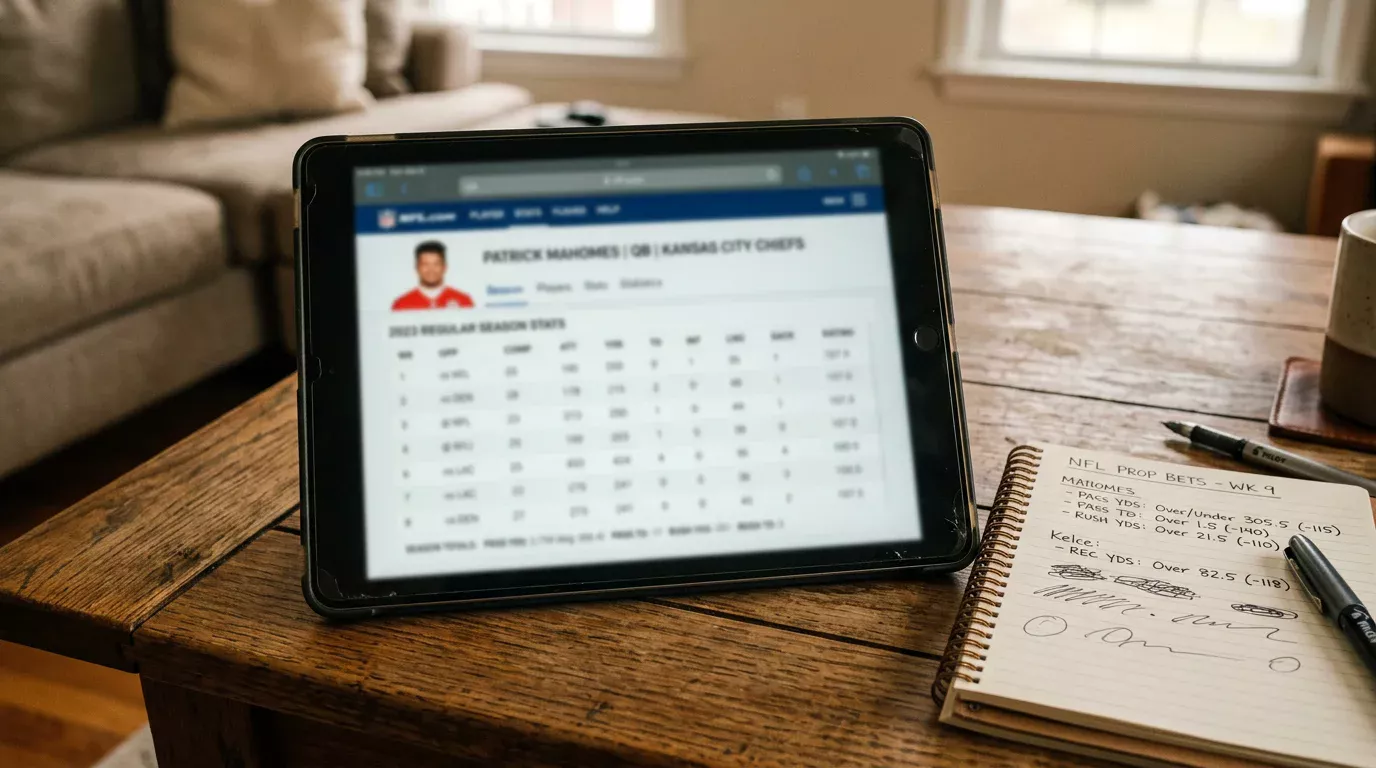
The most common player props in the NFL fall into a handful of categories. Passing yards and passing touchdowns for quarterbacks. Rushing yards and rushing attempts for running backs. Receiving yards, receptions, and receiving touchdowns for wide receivers and tight ends. Each of these markets has a line — say, Patrick Mahomes over/under 265.5 passing yards — and you choose a side.
What makes player props interesting is that they’re driven by matchup data rather than team-level outcomes. A quarterback might throw for 310 yards in a game his team loses by 14. A running back might get stuffed for 42 yards in a game his team wins comfortably. The individual performance is its own universe, and that’s where your research pays off. I look at three things before taking a player prop: the player’s recent form over the last three to four weeks, the defensive ranking of the opponent against that specific position, and the game script — is this likely to be a close game where both teams keep passing, or a blowout where the winning team runs the clock down?
One example from my own betting log: in Week 12 of the 2025 season, I noticed a receiver whose targets had increased by 30% over the previous four games after a teammate’s injury. His yardage line hadn’t moved to reflect that extra volume. Over 62.5 receiving yards at 10/11 was a gift, and he finished with 91. That kind of lag between real-world usage and bookmaker pricing is where props get profitable.
Game Props Beyond the Final Score
Not every prop is about an individual player. Game props zoom out slightly and ask questions about the contest itself — just not the final result. These are less researched by casual bettors, which is exactly why I like them.
Common game props include: which team scores first, the method of first score (touchdown, field goal, or safety), the total number of turnovers in the game, whether either team will score in every quarter, the highest-scoring quarter, and the margin of victory. Some bookmakers also offer first-half and second-half props — essentially mini-games within the game.
I’ve had particular success with first-score-method props. The standard line prices “touchdown” as the heavy favourite over “field goal,” but the actual historical split is closer than most punters assume. When two strong defences meet — teams that force punts and keep opponents out of the red zone early — the first scoring play is frequently a field goal after a stalled drive. That scenario gets underpriced because casual bettors default to “touchdown” without thinking about the defensive matchup.
Another game prop worth tracking is total sacks. If a team with a dominant pass rush faces an offensive line that’s been allowing pressure all season, the sack total can be a more predictable market than the game spread. You’re isolating a specific strength-versus-weakness dynamic rather than trying to predict the overall result — and that specificity is what gives props their analytical edge.
Novelty and Entertainment Props at UK Bookmakers
Every February, when the Super Bowl rolls around, the prop markets explode into territory that barely qualifies as sports betting. Coin toss result. Length of the national anthem. Colour of the Gatorade poured on the winning coach. Whether a particular celebrity will be shown in the crowd. The Super Bowl alone attracted a projected $1.76 billion in legal wagers for 2026, and a decent slice of that handle went on novelty props that have nothing to do with football.
UK bookmakers have embraced this category with enthusiasm. During Super Bowl week, you’ll find novelty markets at most major licensed operators — everything from the length of the halftime show to whether a specific song will be performed. These are entertainment bets, pure and simple. The odds are generally wide (meaning the bookmaker’s margin is fat), and there’s no analytical edge to be had on most of them.
That said, I place one or two novelty props every Super Bowl purely for the fun of it. Small stakes, no expectation of profit, just a way to add an extra layer of engagement to the biggest single sporting event of the year. The key is knowing the difference between a novelty bet (entertainment) and a player prop (where analysis actually matters). Don’t confuse the two.
How to Spot Value in NFL Prop Markets
Finding value in prop markets is fundamentally about information asymmetry — knowing something the line doesn’t yet reflect. Here’s my process, stripped down to the essentials.
Start with the injury report. If a team’s number-one receiver is ruled out, the number-two receiver’s targets will spike. The bookmaker adjusts the number-two’s yardage line, but often not fast enough or not far enough. That gap between the adjusted line and the true expected output is your window. I’ve found these gaps are widest on Thursday and Friday, when injury designations (questionable, doubtful, out) are first published.
Next, look at pace of play. A team that runs 70 plays per game creates more statistical volume than a team running 55. If a high-pace offence is facing a defence that allows long drives, the combined play count inflates every counting stat — passing yards, rushing attempts, receptions. Prop lines are set on averages, and when the pace context pushes a game above average, the overs tend to hit more often.
Finally, compare lines across multiple bookmakers. Prop markets are less liquid than spread or moneyline markets, which means bookmakers price them more independently. I’ve seen the same player’s rushing yards line set at 68.5 at one operator and 74.5 at another on the same day. That seven-yard gap is enormous. Always take the most favourable number available to you.
Props Are Where Preparation Pays Off
Spread and moneyline markets are efficient — thousands of sharp bettors hammer the lines into shape within hours of their release. Prop markets, especially player props on less prominent games, don’t get that same level of scrutiny. For a UK bettor willing to dig into matchup data, snap counts, and target shares, props are where your homework translates most directly into an edge. Start small, track everything, and let your results tell you which prop categories suit your analytical strengths.
What are the most popular NFL player props at UK bookmakers?
Quarterback passing yards, running back rushing yards, and wide receiver receiving yards are the three most widely offered and most heavily bet player prop markets. Touchdown scorer props — anytime and first touchdown — are also extremely popular, especially during primetime games and the Super Bowl.
Are novelty Super Bowl prop bets available at UKGC-licensed sites?
Yes. Most major UKGC-licensed bookmakers offer a range of novelty props during Super Bowl week, including coin toss result, national anthem duration, and halftime show specials. These markets typically open one to two weeks before the game and carry wider margins than standard football props.
Find the best options for bet nfl games.
Read our detailed review of NFL Season Structure for Bettors — Conferences, Divisions, Playoffs.
Published by the bet nfl Games team.