NFL Parlay Betting UK — Accumulators, Odds, and Risk
 Available in US
Parlays made up 22% of all sports betting handle in the US in 2024, and bookmakers held over 15% of that money — more than double the hold rate on straight bets. Those two numbers tell you everything about the parlay market in a single breath: punters love them, and the house loves them even more.
In UK betting culture, we call them accumulators — “accas.” Same mechanic, different name. You combine multiple selections into a single bet, the odds multiply together, and every leg has to win for the bet to pay out. The appeal is obvious: turn a fiver into three figures on a Sunday afternoon. The risk is equally obvious: one wrong leg and the entire ticket is dead. I’ve placed hundreds of NFL parlays over nine years, and I’ve developed a very specific view on when they make sense, when they’re a trap, and how the maths actually works beneath the excitement.
How NFL Parlays (Accumulators) Work
A parlay is a single bet that links two or more individual selections. All selections must win for the bet to pay out. If you back three NFL teams to cover the spread and two of them do but the third falls short, you lose your entire stake. There’s no partial credit.
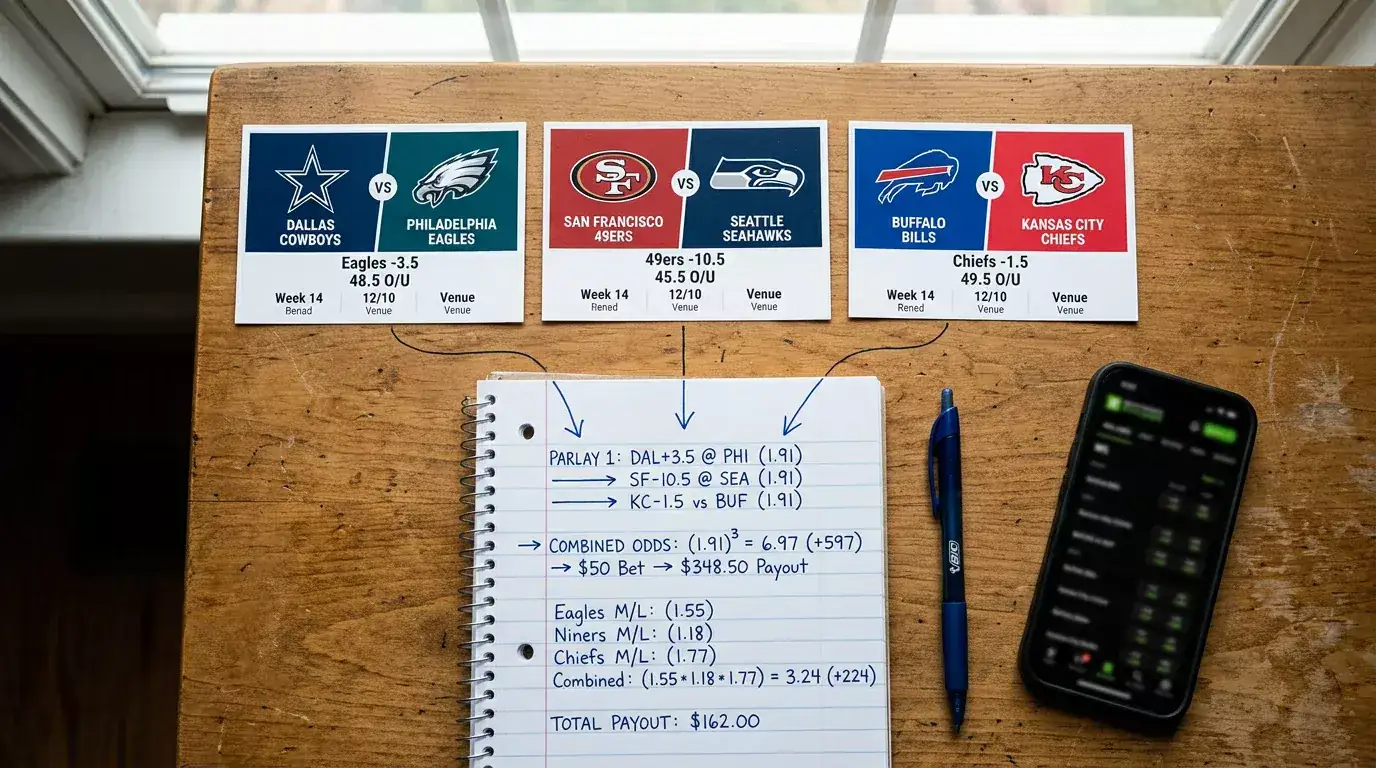
Let me walk through a concrete example. You fancy three Sunday games: the Eagles to cover -3.5, the Bengals to win on the moneyline, and the Packers-Bears total to go over 43.5. At your bookmaker, each individual selection is priced at around 10/11 (decimal 1.91). If you placed three separate 10-pound bets, you’d risk 30 and each winner would return roughly 19.10 — a profit of 9.10 per correct pick.
In a parlay, you combine all three into a single 10-pound bet. The odds multiply: 1.91 x 1.91 x 1.91 = 6.97 decimal. Your 10-pound stake returns 69.70 if all three legs hit. That’s a profit of 59.70 from a tenner — compared to a maximum of 27.30 profit from three separate straight bets. The difference in potential return is what hooks people.
But here’s the catch. With separate bets, going two-for-three still returns a profit: you’d win 18.20 across the two winners and lose 10 on the loser, netting 8.20. With the parlay, going two-for-three returns nothing. Zero. That asymmetry is the entire game. Parlays concentrate your risk in exchange for amplified reward, and concentration of risk is generally the enemy of long-term profitability.
UK bookmakers typically allow parlays with anywhere from 2 to 20+ legs, though the practical sweet spot — if you’re going to play them at all — is two to four. Beyond that, the probability of hitting every leg drops off a cliff. With 290 million online bets placed monthly in the UK, a staggering number of those are accumulators that never cash.
Calculating Combined Parlay Odds in Fractional and Decimal
The calculation is dead simple in decimal format, which is one reason I recommend switching to it for parlay maths. Multiply all the decimal odds together, then multiply by your stake.
Two-leg parlay: Team A at 1.91 and Team B at 2.20. Combined odds: 1.91 x 2.20 = 4.20. A 10-pound bet returns 42.00.
Three-leg parlay: Add Team C at 1.75. Combined odds: 4.20 x 1.75 = 7.35. A 10-pound bet returns 73.50.
Four-leg parlay: Add Team D at 2.00. Combined odds: 7.35 x 2.00 = 14.70. A 10-pound bet returns 147.00.
In fractional format, the process is slightly clunkier. You convert each fractional odd to decimal first: 10/11 becomes 1.91, 6/5 becomes 2.20, 3/4 becomes 1.75, evens becomes 2.00. Then multiply as above. Some UK bookmakers will also display your combined parlay odds directly on the bet slip, saving you the manual calculation.
One nuance: bookmakers don’t always pay true parlay odds. Some apply a small deduction on combined bets, especially for “related” selections where the outcomes aren’t independent. If you’re combining a quarterback’s passing yardage with the same team to win — selections that are clearly linked — the bookmaker will reduce the combined odds to account for the correlation. This is fair, but it’s worth being aware of because it eats into the amplified return that makes parlays attractive in the first place.
The Risk-Reward Maths: Why Bookmakers Love Parlays
I need to be blunt here, because the maths is clear and ignoring it costs real money.
A standard NFL spread bet at 10/11 carries an implied probability of roughly 52.4%. To break even on straight bets at this price, you need to win about 52.4% of the time. That’s achievable with solid analysis. Now stack that into a three-leg parlay. The probability of hitting all three, assuming each leg has a 52.4% chance, is 0.524 x 0.524 x 0.524 = 14.4%. Your actual win rate on the parlay needs to be around 14.4% just to break even — and in practice it’s harder because the combined odds the bookmaker offers are slightly worse than the true mathematical combination.
This gap between the true probability and the bookmaker’s payout is the hold — the built-in house advantage. On straight bets, the hold is typically 4-5%. On parlays, the hold exceeds 15% on average. That’s three times the cost. Every leg you add increases the bookmaker’s mathematical edge, which is precisely why parlays represented 22% of handle but an outsized share of bookmaker revenue in 2024.
None of this means parlays are “bad.” It means they’re expensive. You’re paying a premium for leverage, and whether that premium is worth it depends entirely on context.
When Parlays Make Strategic Sense
After nine years of tracking, I’ve found exactly two scenarios where parlays have a defensible place in an NFL betting strategy.
The first is when you have strong, independent edges on two or three games in the same week. If your analysis gives you a genuine 57-58% win rate on each leg — well above the breakeven threshold — multiplying those edges together can still produce positive expected value even after the parlay hold. The keyword is “independent”: backing three teams from three different games, not three selections from the same match. And the edge on each leg needs to be real, not assumed.
The second is as a small-stake entertainment play. I allocate about 2% of my weekly betting budget to a single two or three-leg acca. Small enough that a loss doesn’t register, big enough that a win feels meaningful. The key is the budget allocation: if your parlay spend is more than 5% of your total weekly handle, you’re almost certainly bleeding long-term value. For structured alternatives to parlays, a disciplined staking approach will serve you better over a full season.
The Parlay Paradox
Parlays are the most exciting bet in the NFL slate and the most mathematically punishing. That tension isn’t a problem to solve — it’s a reality to manage. Use them sparingly, size them appropriately, and never let a parlay replace the straight bets where your analytical edge actually compounds over time. The bookmakers aren’t building lavish offices off straight-bet hold. They’re building them off parlays. Keep that mental image every time you’re tempted to add a fourth leg.
How many legs should an NFL parlay have?
Two to three legs is the practical sweet spot. Each additional leg multiplies the bookmaker’s edge and sharply reduces your probability of winning. Four-plus leg parlays should be treated strictly as entertainment plays with very small stakes, not as a core strategy.
What is a correlated parlay and why do bookmakers restrict them?
A correlated parlay combines selections whose outcomes are linked — for example, a team to win and the game total to go over, since winning teams tend to score more. Bookmakers restrict or reduce the odds on correlated parlays because the true probability of both legs hitting is higher than the odds of independent events would suggest, which would give the bettor an unfair mathematical advantage.
Find the best options for bet nfl games.
Read our detailed review of NFL Playoffs Betting UK — Postseason Markets and Angles.
Written by the editors at bet nfl Games.